
 AT
AT
 DE
DE
 DE
DE
 UK
UK
 INT
INT

Management approach – our why
As a manufacturer, our goal is to use resources efficiently and reuse them as effectively as possible. EVVA’s environmental policy (available at https://www.evva.com/int-en/aboutus/company/#tab4 ) places particular emphasis on the sustainable use of resources.
Although EVVA’s circular economy concepts are diverse, as described below, the path to a more circular economy is challenging. The materials that EVVA uses as a production company do not fully return to the cycle. EVVA has therefore identified the inflow and use of resources as a material negative impact. As a production company, we also have a higher resource requirement than companies in other industries. Beyond our own business activities, this mainly affects our upstream value chain.
Our approaches to an active circular economy (ESRS E5-1)
EVVA requires resources such as brass, nickel silver, cardboard and paper to manufacture security cylinders and keys. The potential for conserving resources lies in purchasing, the use of resources in production and product planning. The vast majority, 95%, of raw materials are purchased via the Vienna headquarters for all EVVA branches. Since the EVVA Group’s resource inflow is therefore practically only driven through one location, the data specified here refers to the EVVA headquarters. The remaining 5% are marginal in the overall picture.
Circular economy concepts are planned, implemented and monitored by EVVA units such as Logistics & Purchasing, Production and Research & Development. The upstream value chain is essential for a circular economy at EVVA. We are therefore in ongoing dialogue with our main suppliers in order to make the most of recycled materials in our resource inflow.
Our actions to use resources more sustainably (ESRS E5-2)
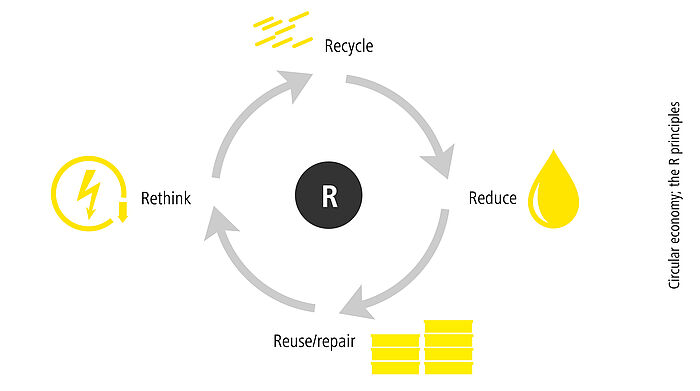
EVVA has implemented several circular priorities in the reporting year and in recent years, as reflected in the following overview of our “R” concepts and measures.
Recycle
EVVA places a strong focus on recycling in order to recover the materials used as effectively as possible.
- Brass and nickel silver are by far the most important materials for our production. EVVA reuses the metal shavings produced during the processing of our access solutions at our headquarters – and has been doing so for many decades. They are melted down at the supplier and returned in full to the production process
- EVVA purchases a high proportion of recycled materials in the upstream value chain. Already 90% of our brass comes from secondary materials. More details can be found in the target description below under Recycling materials
- Our product packaging for sale has been made from 100% environmentally friendly, recyclable cardboard since 2017. For more information, see Recycling materials
- A vacuum evaporator treats 100% of the wastewater from the electroplating process and returns it to the production cycle. For more information, see Water and wastewater recycling
- Another reason for our high recycling rate is that EVVA is increasingly using a special machining technology for complex product parts, which separates excess material in the form of chips, thereby increasing recycling
Reduce
Even better than recycling is reducing the need for resources altogether. EVVA can point to many years of successful measures.
- EVVA’s Clean Production protects the environment and resources by operating dry – meaning it produces without oil, emulsions or water. More information under Clean Production
- Energy: Our need for fossil energy is continuously decreasing, through energy saving measures, the expansion of our own photovoltaic systems and environmentally conscious energy procurement. EVVA already sources 100% of its purchased electricity from renewable energy sources at headquarters. More information under Energy & Emissions overview, Photovoltaics and Power management
- Paper. By switching to digital processes, EVVA has been able to save several tonnes of paper at the headquarters in recent years. More details can be found in the target description below under Recycling materials
Reuse/Repair
EVVA products have a very high durability, which means end users can make use of them over a long period of time. EVVA cylinders can be removed and reused for similar door applications, e.g. when moving house. EVVA uses reusable transport packaging in its own business activities, as well as in the downstream value chain.
- According to the EPD (Environmental Product Declaration, available under Certifications ) – voluntary environmental declarations for individual building products that indicate the life cycle assessment of buildings – the service life of a mechanical locking cylinder is 30 years and 100,000 locking cycles. These are anything but disposable products with only a short lifespan. EVVA continues to receive many reorders of systems that have been in use for half a century or more
- EVVA offers a repair service; electronic components, for example, are checked at EVVA’s ELREZ (electronics repair centre)
- Internal packaging/reusable pallets. In recent years, EVVA has increased its share of reusable internal packaging to around 90%. For more information, see Recycling materials
Rethink
Product development and design have a positive influence on resource use. In addition to economic requirements (how must the product be developed to generate profit?) and social requirements (how can safe use be guaranteed?), EVVA also considers ecological impacts in its product design.
- Sustainability is embedded in EVVA’s R&D specifications and product lifecycle management. New products are assessed accordingly across their life cycle (e.g. recycling potential; minimum energy consumption over the average period of use; connected devices that enable maintenance via radio, etc.)
- Low power design. EVVA uses advanced semiconductor technologies for electronic access solutions, which are also used in smartphones and wearables. This means that batteries last significantly longer. For more information, see Permanent Innovation
- The modular design of locking cylinders can reduce waste. For more information, see Permanent Innovation
- Brass contains a very small proportion of lead, which makes machining (manufacturing processes such as turning, drilling, or milling) possible in the environmentally friendly clean production process. "A complete ban on lead in the door hardware must be questioned from a health perspective, as the proportions and so-called lead leaching are minimal. In the interests of sustainability, however, we are also researching alternative materials that continue to enable a fast cycle time, high durability and clean production," explains Johann Notbauer, Group Division Manager of Market Innovation and Technology at EVVA.
Another way to conserve resources is to offer the function of a product in a different form. The sharing economy is an example of this.
- EVVA offers key credits for the Xesar and AirKey electronic access systems. End users can share and revoke access to their properties via their smartphone. Access authorisation is no longer via physical keys or cards, but via a smartphone. For a new access authorisation, e.g. for a cleaning service or for assisted living, no new key is produced in this model, but instead a virtual KeyCredit is used to authorise the third-party smartphone for access
Resource inflows (ESRS E5-4)

| Input (kg) | 2025 | 2024 | 2023 |
|---|---|---|---|
| Brass | 676,334 | 821,731 | 800,107 |
| Key blanks | 91,122 | 78,437 | 88,947 |
| Nickel silver | 28,984 | 39,000 | 16,553 |
| Cardboard packaging | 38,637 | 44,084 | 43,145 |
| Plastics | 2,404 | 4,753 | 6,951 |
| Screws, nuts … | 44,026 | 49,282 | 66,864 |
| Electronic components | 2,166 | 1,818 | 2,701 |
| Paper | 4,836 | 4,372 | 4,557 |
| Steel | 6,232 | 5,517 | 12,987 |
| Zinc die-cast parts | 2,414 | 1,543 | 5,206 |
| Brochures | 1,440 | 1,515 | 1,565 |
| Total | 898,595 kg | 1,052,052 kg | 1,049,583 kg |
| Water | Data to be released in 2026 | 4,191 m³ | 4,050 m³ |
| Oil | 9,500 l | 9,332 l | 14,935 l |
For information on electricity/gas, see Energy & Emissions Overview
As the table of resource inflows shows, brass is by far the most important resource for EVVA and is therefore prioritised in our circular economy efforts. It is the main material for locking cylinders and keys.
- In 2024, EVVA built up its inventory and procured more brass and nickel silver to be well-prepared for unexpected supply disruptions. In 2025, inventory levels were reduced again.
- Inventory levels of key blanks were increased in 2025.
- In 2025, EVVA upgraded its packaging to a higher quality standard and shipped more products using its own reusable pallets. This reduced the need for cardboard packaging.
- Plastic input was lower as inventory was reduced and more reusable packaging was used.
- In 2025, a similar amount of paper was purchased as in 2024. However, since significantly less was consumed in 2025, this will be reflected in the next reporting year with lower paper input figures.
All of the following goals continue to drive EVVA’s circular economy forward. In doing so, we aim to increase the circular material utilisation rate and further minimise the consumption of primary raw materials. EVVA’s measures to become more independent of fossil energy sources are described under Energy & Emissions Overview.
By when:
Target year: 2028. Base year: 2025
Scope and positive effects:
Brass is the most important metal for EVVA production and accounts for approximately 80% of total metal requirements. 100% of the brass shavings produced during EVVA's manufacturing process are already melted down and recycled. This accounts for approximately one third of the current recycling rate of 90%. The other two thirds come from the scrap trade of our suppliers. Together with them, we are now trying to increase this figure to an even higher 94%. This would further significantly reduce the demand for primary raw materials.
Method, validation:
Ongoing cooperation with suppliers to promote recycling; confirmation of the recycling rate by brass suppliers.
Value chain/location:
Upstream value chain, EVVA headquarters in Vienna
Target pursuit:
‘Logistics & Purchasing’ department
By when:
Target year: 2030. Base year: 2024
Scope and positive effects:
Nickel silver is the second most important metal for EVVA production and accounts for approximately 12% of total metal requirements. Currently, 75% of the nickel silver purchased comes from recycled materials. In consultation with our main supplier, we want to increase this figure to 90% in order to keep the proportion of primary materials to a minimum.
Method, validation:
Ongoing cooperation with suppliers to promote recycling; confirmation of the recycled content by nickel silver suppliers.
Value chain/location:
Upstream value chain, EVVA headquarters in Vienna
Target tracking:
‘Logistics & Purchasing’ department
By when:
Target year: 2027. Base year: 2019
Scope and positive effects:
The planned reduction from 8.3 tonnes (2019) to 3.4 tonnes (by 2027) will result in savings of around 60%. EVVA is promoting paperless production and digital order processing. Copy paper in thicknesses of 3.82 g and 4.28 g accounts for the majority of our paper consumption. Our need for this will decrease accordingly due to digitalization.
Method/validation:
Status of consumption values from the internal ERP (Enterprise Resource Planning) system.
Location/value chain:
EVVA headquarters in Vienna
Target tracking:
‘Mechatronics Production’ division
How would you like to share?