
 AT
AT
 DE
DE
 DE
DE
 UK
UK
 INT
INT

Regional sourcing = Sustainability
The pandemic and the Ukraine war have led to a reassessment of many priorities. Regional sourcing has been given special importance. Lean global supply chains remain important, but close relationship with nearby suppliers has gained significance. EVVA had already focused on regional sourcing and maintaining a high level of value creation before the coronavirus pandemic, because
- it makes us less dependent of distant suppliers, thereby increasing security of supply and reducing the risk of delivery disruption during times of crisis,
- shorter transport routes generate lower CO2 emissions and therefore support climate neutrality,
- working with nearby suppliers helps to preserve jobs within the region.
Share of suppliers by materials
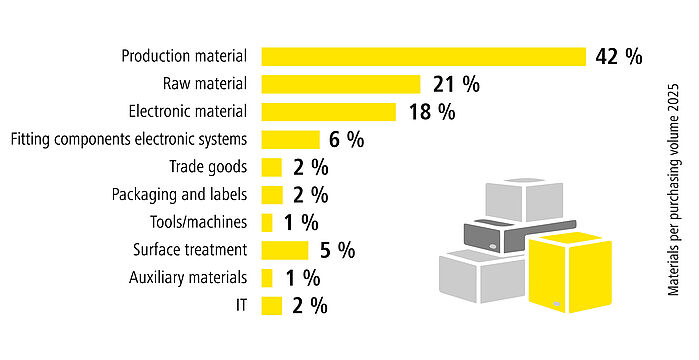
The “Logistics & Purchasing” department at EVVA headquarters is responsible for central procurement across the Group and has analysed the regional proximity of its suppliers:
- EVVA works with around 400 suppliers to manufacture high-quality mechanical and electronic access systems. Among other things, these suppliers provide the raw materials required for production (primarily brass) as well as for product components and tools
- Of EVVA's top 100 suppliers, 56 are based in Austria (41 of them from Vienna, Lower Austria, Burgenland). Around 58% of the headquarters’ purchasing turnover is generated within a radius of 500km of Vienna
98% regional suppliers
As virtually all materials and product components for the international EVVA Group are procured through the headquarters in Vienna, EVVA defines suppliers located within a radius of 1,000 km of the headquarters as regional sources. The vast majority of our suppliers are based within this area. EVVA successfully achieved its goal of increasing the share of regional supply sources from 93% to more than 95% by 2024! In 2025, this figure has increased to 98%, as EVVA now sources additional components from Europe rather than overseas.
We deliberately refer to “regional” rather than “local” suppliers for two reasons. Firstly, this reflects the EU's concept of a 'Europe of the Regions', which promotes regional autonomy. From a CO₂ perspective, a supplier in nearby Bratislava is no less regional than one located in the more distant Austrian province of Vorarlberg. Secondly, many of EVVA’s key material manufacturers – with whom we have maintained close business relationships for decades – are based in Central and Eastern Europe.
High share of regional EVVA suppliers


- EVVA purchases the vast majority of materials and components from European sources. And approx. 2% from Asian, such as key fobs, key tags or stainless-steel components for electronic handles
- Very stable and long-standing business relationships: EVVA has maintained this with its main suppliers for decades, often spanning several generations. In fact, EVVA has maintained close business relationships with 70% of its regional suppliers for at least 25 years
Challenges
As the above list shows, EVVA cannot source every component required for production from regional suppliers. For certain product categories, there is virtually no competitive regional industry remaining. The production of fittings for electronic access systems, for example, is labour-intensive and purchasing of raw materials is more expensive than importing finished products. As a result, much of the European fittings industry relocated to Asia – particularly to China. However, this shift also created challenges arising from differing corporate cultures, ways of working, communication barriers and geographical distance. These challenges were further compounded by a lack of transparency within supply chains. For this reason, EVVA adopted a new approach to fittings production:
Strengthening the fittings industry – from Asia back to Europe
In 2023, together with one of its European suppliers from the fittings industry (d line in Denmark), EVVA re-established a former fittings production facility in Lithuania. EVVA and d line were thus able to shorten response and delivery times, bring raw material processing back to Europe and maintain high quality standards within their own production processes. An additional benefit is that these supply chains are shorter, closer to home and significantly more transparent.
How would you like to share?