
 AT
AT
 DE
DE
 DE
DE
 UK
UK
 INT
INT



Management approach - our why
As a production company, EVVA consumes more electricity than similarly large companies in other industries. New machines make manufacturing more efficient and replace many old oil-based installations, but increasing digitalisation and connectivity require more energy. Our ongoing switch from gas to electricity will reduce greenhouse gas emissions on the one hand, but increase electricity demand on the other. EVVA tries to counteract this with energy-saving measures and its own clean energy sources.
Our analysis also showed the possibility that energy-saving measures can provide a quick return on investment in addition to the environmental benefit, i.e. that the investment costs are often recovered after a short period of time. One example is the switch to new compressors with waste heat utilisation at the EVVA headquarters: this high investment will pay for itself in just 2 to 3 years due to the lower energy costs. This shows that measures with an excellent cost/benefit ratio for people and the environment are possible.
Our goals and actions to save and use energy more efficiently (ESRS E1-3 and E1-4)
EVVA has implemented or planned the following objectives and measures. They initially refer to the EVVA headquarters with the main production site. You can find out more about our own renewable energy sources under Photovoltaics.
Notes on the table:
-
The methodology and validation of objectives includes: our own energy management system with a database, own measurements and information from external service providers (compressor manufacturers)
-
The targets are evaluated by the EVVA “Global Industrial Engineering” or “Mechatronics Production” units
| EVVA goals | Planned kWh reduction | Starting Year | Target Year | Progress |
|---|---|---|---|---|
| Comprehensive energy consumption analysis for entire production | -- | 2024 | 2025 | 100% |
| Reduce total energy demand by up to 10%, e.g. through heat return from the new compressors | up to 550,000 kWh | 2024 | 2025 | 100% |
| Purchase of two more energy-efficient compressors incl. Smart Optimizer | 371,000 kWh | 2024 | 2025 | 100% |
| Use of the waste heat from new compressors | 1,210,000 kWh | 2024 | 2027 | 50% |
| Eliminate leaks in the compressed air system | 160,000 kWh | 2020 (start of first small projects) | 2026 | 80% |
The implementations in detail:
- Energy management with precise consumption analyses
EVVA is establishing a new digital energy management system to make electricity and gas consumption easier to monitor and faster to access. It puts the efficiency and effectiveness of our energy saving measures on an even more professional footing. The technical installations will be successively fitted with consumption meters to measure individual energy requirements. The analysis covers all production areas and will be completed in 2025/2026. Around 80 sensors have already been installed for this.
Positive effects:
Knowing exactly what consumes how much energy makes it possible to derive precise measures. On the one hand, the required demand should continue to be available in a fail-safe manner; on the other hand, potential for electricity and cost savings should be identified and exploited at the push of a button. This energy monitoring has considerable positive effects on climate protection and economic efficiency.
The analyses revealed inefficiency in the compressed air consumption of a key machine. Solution: The compressed air supply is shut off as soon as the machine is idling, to avoid unnecessary power consumption
-
Reducing total energy consumption by around 10%
Revenue growth and energy savings do not have to be mutually exclusive. EVVA has set a target for 2025 to reduce its total energy consumption (electricity and gas) at its headquarters by up to 10%. This has been successfully achieved through the measures described in this report, e.g. through heat recovery from the new compressors and lower electricity consumption for compressed air.Positive effects:
Although the originally planned saving of 550,000 kWh was not quite achieved, it was nearly reached. The 408,000 kWh ultimately saved still represents a 7% reduction in total energy consumption 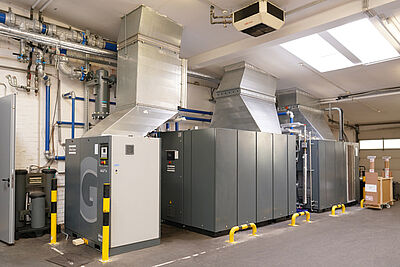 Purchase of additional more energy-efficient air compressors and integration of their waste heat into the heating return
Currently, 3 compressors (photo) are in use at the headquarters for the production of security cylinders, keys, etc. Old devices have already been replaced with more modern ones in recent years. The compressors purchased since 2024 are equipped with a smart control system (Smart Optimizer) that controls the compressors according to demand and therefore more energy-efficiently. The Smart Optimizer prevents idle times (no more standby energy losses) and thus energy waste.
Positive effects:
This results in operational savings of 371,000 kWh per year, most of which is achieved through the Smart Optimizer. Compressor investments in the six-figure euro range pay for themselves after just 2 to 3 years thanks to the energy costs saved. The Smart Optimizer itself pays for itself in just a few weeks. Another major advantage: EVVA can use the waste heat from the compressors to gradually replace the gas previously required for heating. The estimated energy savings from heat recovery are expected to amount to 1,210,000 kWh, or 1.21 GWh, by 2027 (more on this under CO2 neutrality)
 Eliminate leaks in the compressed air system
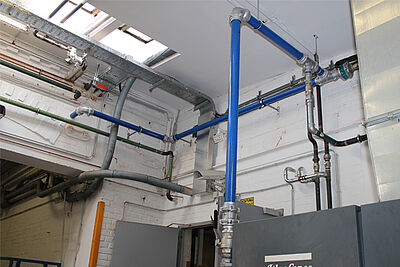
Compressed air generation is one of EVVA’s largest power consumers. EVVA currently requires around a third of its total electricity requirements for compressed air generation. Compressed air (blue lines in the photo) is therefore a key area of focus for the company in saving more energy in the future, e.g. through the new, more energy-efficient compressors already mentioned and also by eliminating leaks. Leaks occur mainly in the supply lines to machines and equipments (directly at the valves) and cause unnecessary energy consumption. They are identified using measuring instruments and should be gradually eliminated.
Positive effects:
EVVA wants to save 160,000 kWh at the headquarters – which corresponds to the electricity consumption of around 45 private households (assumption: 3,500 kWh consumption per household)
- Digital building management system
A modern building management system (BMS) helps to use energy efficiently because it can control heating, cooling and fire alarm systems digitally and centrally. The prerequisite for this is recording and knowing the exact power consumption of each production area. The BMS was fully installed in the new extension in 2022, but it is much more difficult to implement in the older parts of the building (in which EVVA has been producing since 1955). Once energy management is firmly established with comprehensive electricity analyses, EVVA will also consider BMS similar to those used in the new extensions, such as automatic heating/cooling control based on outdoor temperature (which can replace air conditioning systems) or the intelligent use of machine waste heat within the production hall during winter
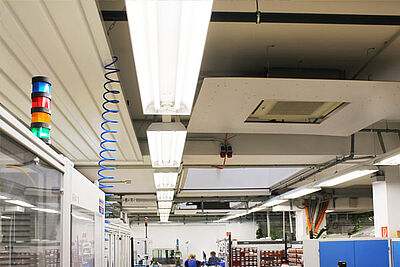 Lighting changeover to LED
In recent years, EVVA’s headquarters have been able to reduce electricity consumption by around 130,000 kWh per year by converting to LED lighting (pictured on the right). The LED conversion at the Krefeld (savings of approx. 60,000 kWh) and Tišnov (savings of approx. 20,000 kWh) sites has also already been successfully completed
- Virtual servers and free cooling
EVVA already uses virtual servers for many hardware systems, resulting in lower energy consumption. There are currently 350 virtual servers in use at the headquarters, which are operated on 6 physical servers. EVVA also relies on virtualisation technology at its other locations. As a result, each EVVA service can be handled via its own server, which greatly reduces dependencies (e.g. during reboots). Resulting energy savings: EVVA only needs around 70,000 kWh per year for the servers – in contrast to the many dozens of servers in previous years with a total of around 450,000 kWh per year.
The server rooms at the headquarters have been cooled using natural cooling for many years. This means that when the outside temperature is approx. 10 degrees below the desired inside temperature, cooling is no longer carried out via compressors, but via the outside air
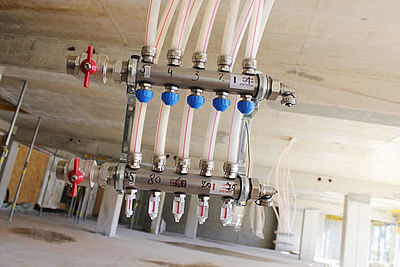 Concrete core activation
The extension at the headquarters received a concrete core activation (also called component activation) for optimal heating and cooling. Hoses in which water can circulate as a heating or cooling medium are cast directly into the ceilings (see photo). The flow-through ceilings are thermally activated as transfer and storage mass. They absorb or dissipate heat over their entire surfaces, ensuring a uniform temperature throughout the year. Due to the large transfer surfaces, water does not have to be heated as much as, for example, with conventional central heating using radiators. The concrete core activation is integrated into the extension's central building management system (BMS) and works with air source heat pumps
- Renovation of several roof structures including thermal insulation, see CO2 neutrality
- For the extension of EVVA’s own photovoltaics, see Photovoltaics
How would you like to share?